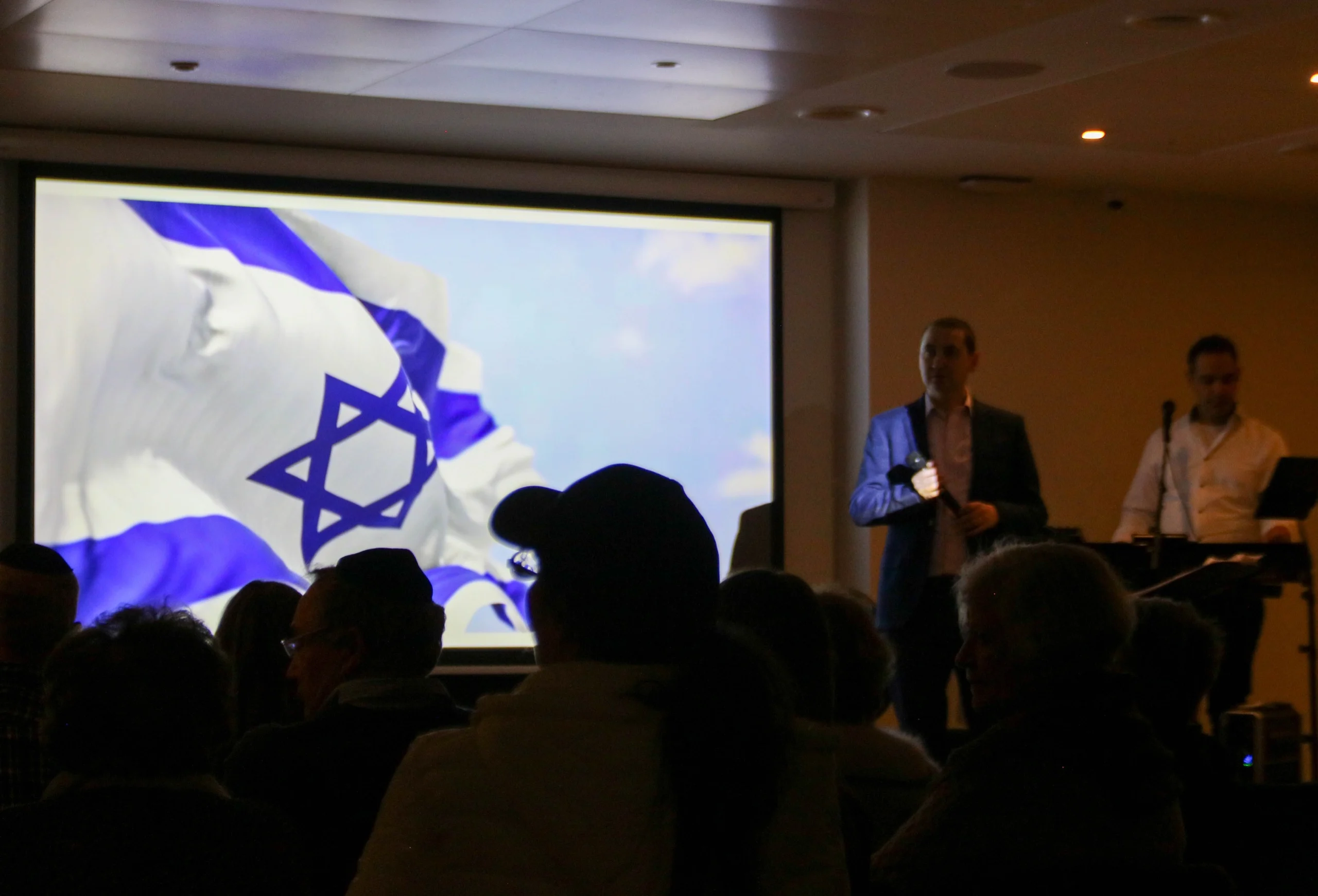
Early in my time at BNJC we had a visit from Miriam Margolyes. I have enjoyed a good deal of her work as an actor, Professor Sprout included, and she is very funny. Many of her personal opinions, though, I find incredibly difficult, those about Israel above all, and I know that many people in our community feel the same way, often far more strongly than I do.
One exchange of hers has stayed with me all the same. In his Channel 4 documentary Jews Don't Count, David Baddiel, another person I disagree with on many things, possibly most, talked with her about Israel and the Jewish people. Baddiel described himself as an atheist and a European Jew who feels no particular connection to Israel, no more than to any other foreign country, and argued that holding British Jews responsible for what Israel does is antisemitic. Margolyes saw the connection very differently. Israelis are her people, she argued, and that connection is exactly why she feels a duty to speak out when she thinks Israel is in the wrong.
I disagree with almost everything Margolyes goes on to say about Israel. It was the fiercer critic of Israel, though, who insisted that it has everything to do with Jews, and on that point, and only that one, I found myself agreeing with her: whatever you make of the news on any given day, Israel is bound up in the story of the Jewish people.
Look at how that story is told. It begins with one family being told to leave the land where they lived and go 'to the land that I will show you'. It continues with a people walking out of slavery in Egypt towards that same land, a journey that ends up taking forty years in the desert. Whether you read the Bible as history, as revelation or as literature, it is the text the Jewish people have inherited, and from beginning to end it is the account of a journey to Israel. Its very last verse, in the order the Hebrew Bible is printed, has the Persian king Cyrus inviting the exiles in Babylon to go back up to Jerusalem. For centuries afterwards, Jews who never set foot there faced Jerusalem when they prayed and ended the Seder with 'next year in Jerusalem'.
The connection in these texts is with a place as much as with a people. A large part of Jewish law applies only in the land itself, to its fields, its harvests and its sabbatical years, and the festivals follow its seasons: Pesach comes with the barley, Shavuot with the wheat and Sukkot with the gathering of the autumn harvest. Jews all over the world pray for rain in the season when Israel needs it, which is not always the season when Sussex does. The land also has people living in it today, Israelis with their own music, food, language, humour and arguments, who are as much a part of the Jewish story as the places in the Bible.
A Judaism without Israel would have to leave out most of its own story, which is why understanding the land and its people, and developing a connection with both, is part of understanding ourselves.
So what does that connection look like for a community in Brighton?
Part of the answer is already here. Brighton is lucky to have many Israelis living in the city, and a good number of them are part of our community. Feelings about Israel run high here, and the tensions that come with them are real. Politics aside, one of the most useful things a community can do about those tensions is to create settings in which people actually meet each other.
The philosopher Emmanuel Levinas built much of his work around that kind of meeting. He was born in Lithuania in 1906 and made his life in France, and he spent the Second World War as a prisoner of war in Germany while most of his family in Lithuania were murdered. Alongside his philosophy he gave public readings of the Talmud for decades. His central claim is that moral obligation begins in the encounter with another person's face, before any theory or set of principles. A face is exposed and defenceless, and before I have formed any view of the person in front of me it asks something of me. Levinas described the first thing it says as 'Thou shalt not kill', and he thought that everything else we owe each other grows out of that moment of being addressed.
In practice this means it is much harder to reduce a person to a position once you have sat opposite them. A view about Israel can be argued over at a distance, but an Israeli you know by name, whose children play with yours, is harder to turn into a headline. Levinas insisted that my responsibility to another person does not depend on whether they feel the same about me. In a community, though, the encounter runs in both directions at once, because everyone in the room is also somebody else's other. Israelis who meet British Jews from across the community, and Brightonians, Jewish or not, who meet Israelis, each find themselves facing someone they have some responsibility towards.
That is what our bnot sherut are here to do. They are young Israeli women who give a year of national service (sherut leumi) and spend it with us. They support our nursery, bringing Israeli songs and stories into the day, they help run our arts and youth programming and our family events, and they help support our shabbatonim (Shabbat weekends away). Having them here is a statement of our commitment to the State of Israel, to its land and to its people, and it says something about what that commitment means for a diaspora community. We do not live there, but the connection is real, and it is built by people getting to know each other.
For some of the children they work with, a bat sherut (one of the young women on national service) is the first Israeli they have got to know. For others, from Israeli families, she is a return to a culture they left behind and miss, or feel they have lost touch with. For some of the adults around them she opens a space that can be hard to find elsewhere. Many Jews in this country keep parts of their identity out of sight, and the parts connected to Israel most of all, because it is more comfortable that way. Around the bnot sherut, people can be open about that side of themselves, in whatever form it takes for them.
Whatever your views on Israel, and at BNJC there are plenty, we hope you will come and meet them. The disagreements will still be there afterwards, but they tend to go better face to face.
Sources: Bereishit (Genesis) 12:1; Shemot (Exodus) 3:8; Bamidbar (Numbers) 14:33; Divrei HaYamim (2 Chronicles) 36:23; Talmud, Berachot 30a; Emmanuel Levinas, Totality and Infinity (1961) and Ethics and Infinity (1982); David Baddiel, Jews Don’t Count (2021) and the Channel 4 documentary of the same name (2022).